

The Conscious Comfort Zone: The Hidden Psychology of Stepping Into Visibility
A research-rooted exploration of why women hold back, how belonging shapes presence, and what it actually takes to move from comfort → stretch → visibility → impact.
There are moments women know well.
The ones where you feel something rising — a thought, an idea, a truth — and then a quiet inner voice whispers:
“Not yet.”
“Don’t take up too much space.”
“Make sure it’s perfect first.”
It’s not a lack of confidence.
It’s not a lack of capability.
It’s something else — something quieter, older, culturally inherited.
Women are conditioned, both subtly and explicitly, to equate visibility with risk.
Risk of judgment.
Risk of misinterpretation.
Risk of threatening belonging — the most fundamental human need.
And so, without even realizing it, we learn to stay in the places that feel familiar.
Safe.
Expected.
Invisible.
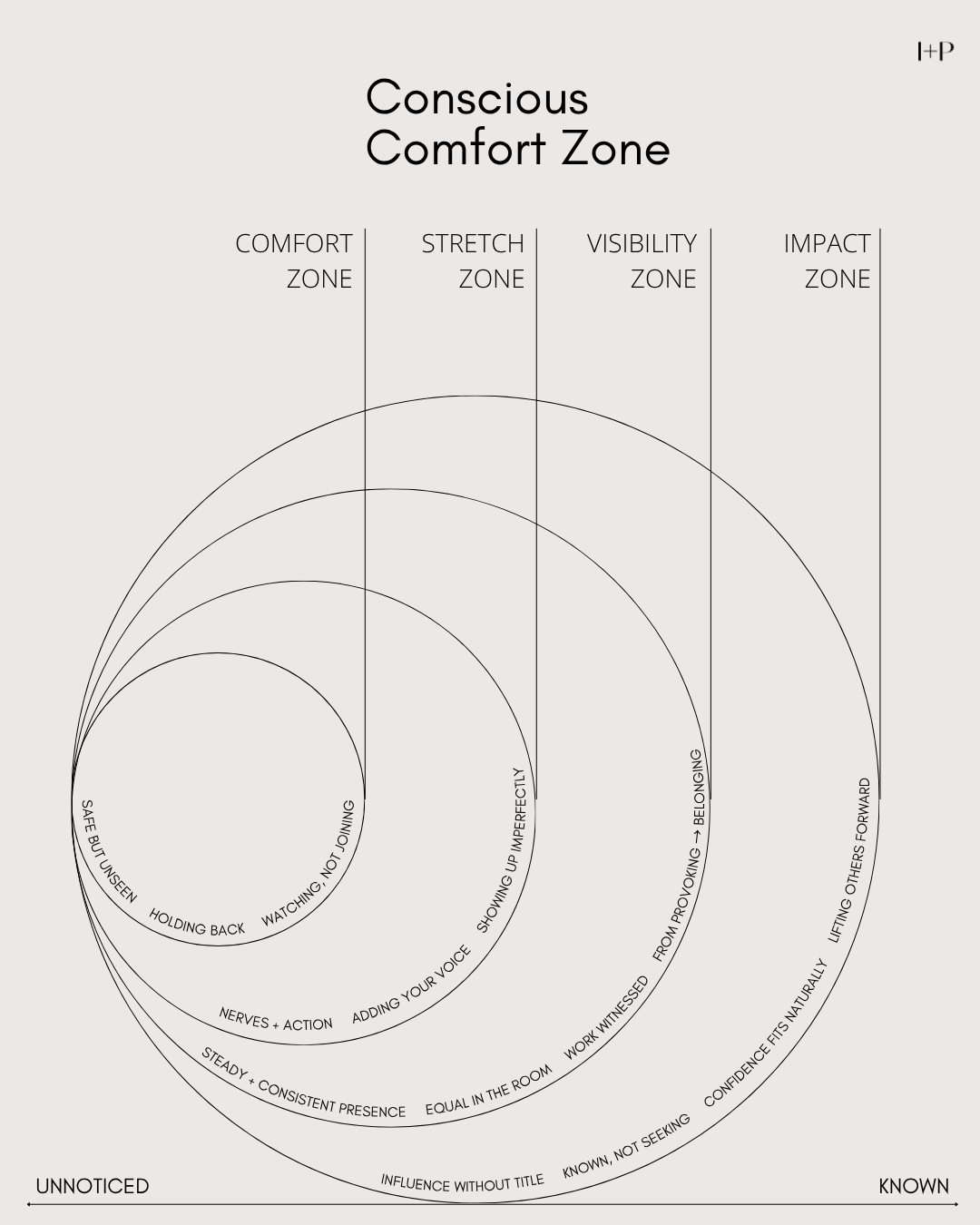
This is the psychology behind your Conscious Comfort Zone.
This is a way to think about the zones we live in — not to show “growth stages,” but to reveal the inner zones women move through when they’re deciding whether to be seen.
This spiral isn’t linear.
It’s cyclical.
Fluid.
A living map of how presence evolves — and sometimes retreats — depending on safety, identity cues, and emotional context.
Why Women Stay Unseen (Even When They’re Ready to Be Seen)
Research consistently shows that women are more likely to internalize self-effacement norms — the belief that being visible is the same as being arrogant, or “too much.”
This happens long before corporate life:
In classrooms where girls are praised for being “good” rather than being bold.
In families where harmony is valued over disruption.
In cultures where female ambition is still quietly policed.
Adam Grant captures this perfectly in Think Again: “We judge women for showing ambition and men for lacking it.”
And Brené Brown’s data echoes this same tension: Women often carry “a double bind between being seen and being safe.”
So it’s not surprising that women spend years learning to:
stay small to stay included
minimize to avoid scrutiny
contribute, but not stand out
help, but not claim space
Visibility becomes linked with threat.
And psychological safety becomes the baseline for whether a woman steps forward — or stays silent.
This is the emotional terrain of the Conscious Comfort Zone.
ZONE 1
Comfort — Safe but Unseen
“Safe but unseen.”
“Holding back.”
“Watching, not joining.”
This zone isn’t failure.
It’s survival.
Women stay here because:
it protects belonging
it avoids scrutiny
it fulfills social expectations
it limits vulnerability
This is the zone where self-silencing feels natural — or even responsible.
Belonging matters.
And when belonging feels fragile, visibility feels dangerous.
ZONE 2
Stretch — Nerves + Action
“Nerves + action.”
“Adding your voice.”
“Showing up imperfectly.”
This is the most important zone — the one where the psychological shift begins.
Women don’t move from comfort to visibility because they suddenly feel confident.
They move because they allow themselves to speak even while nervous.
This is where Brené Brown’s work on vulnerability is essential:
“You are worthy of being seen and heard simply because you exist.”
The stretch zone is where women experiment with that truth.
It’s where you unlearn the idea that visibility must be earned through perfection or overperformance.
This is where leadership begins — quietly, internally, in the moments where you choose contribution over safety.
ZONE 3
Visibility — Work Witnessed
“Work witnessed.”
“Equal in the room.”
“Confidence fits naturally.”
Visibility isn’t about volume.
It’s about congruence.
It’s the shift from:
“Do I belong here?” →
“I am part of this room.”
Amy Edmondson’s research on psychological safety explains what makes this possible:
When teams foster belonging, individuals feel safer to speak — and more willing to share imperfectly.
This is when women realize:
Your work was never the issue.
Your voice was never the issue.
The conditions around your voice determined how freely you could use it.
Visibility emerges when safety expands.
ZONE 4
Impact — Lifting Others Forward
“Known, not seeking.”
“Lifting others forward.”
“Influence without title.”
Impact does not require authority.
Impact requires presence.
This is where leadership becomes unmistakable — even without a title:
You shape conversations.
You anticipate needs.
You help others find their voice.
You influence culture through who you are, not through positional power.
Organizational psychologists Lynn Shore and Jane Dutton show that inclusion, recognition, and visibility are socially conferred — not just merit-based.
Meaning:
Impact is relational.
Influence is human.
Visibility is a system, not a reward.
And women operate at this level long before anyone names them “leaders.”

The Real Insight: Visibility Is an Internal Evolution, Not an External Achievement
The Conscious Comfort Zone is not a hierarchy or a ladder.
You don’t “graduate” from one zone and never return.
Women cycle through these zones depending on:
the room
the stakes
who is watching
who is listening
who is judging
who is supporting
and who is missing
The question is never:
“Am I confident enough?”
The real question is:
“What zone am I in?”
“What’s influencing that?”
and
“What do I need to feel safe enough to step forward?”
Because every step forward conditions your nervous system to trust visibility again.
Comfort → Stretch → Visibility → Impact
is not a performance arc.
It’s a presence arc.
So Why Does This Matter for Women’s Leadership?
Because women often believe they need:
more confidence
more certainty
more evidence
more permission
more validation
when what they actually need is: awareness.
Awareness that:
you’ve been conditioned to associate visibility with danger
your nervous system is responding to old rules
belonging and safety shape your voice more than confidence ever will
you are already leading in many domains of your life
you don’t have to wait for perfect answers to contribute
leadership is often practiced before it is recognized
And most importantly:
Don’t self-cancel in the moments your voice is already in the room.
You’re not walking into visibility empty-handed — you are arriving with years of practiced, lived leadership.
You Are Already Ready
Visibility isn’t a reward.
It’s a practice.
A practice of:
choosing presence over perfection
choosing contribution over silence
choosing self-recognition over self-cancellation
Because the truth is simple:
You have been navigating complex emotional and relational systems your entire life.
You have been leading long before anyone gave you a title.
You are already equipped for visibility.
The Conscious Comfort Zone doesn’t tell you who to become.
It helps you recognize who you already are.
REFERENCES
Brown, Brené. Daring Greatly: How the Courage to Be Vulnerable Transforms the Way We Live, Love, Parent, and Lead. Gotham Books, 2012.
Grant, Adam. Think Again: The Power of Knowing What You Don’t Know. Viking, 2021.
Shore, Lynn M., et al. “Inclusion and Diversity in Work Groups: A Review and Model for Future Research.” Journal of Management, vol. 37, no. 4, 2011, pp. 1262–1289. https://doi.org/10.1177/0149206310385943.
Dutton, Jane E., and Emily D. Heaphy. “The Power of High‐Quality Connections.” The Oxford Handbook of Positive Organizational Scholarship, Oxford UP, 2012.
Phipps, Alison, and Eunice Okoro. "Women, Visibility, and Organizational Silence." Gender, Work & Organization, vol. 28, no. 4, 2021, pp. 1304–1320. https://doi.org/10.1111/gwao.12682.
