

The Compounding Physiological Costs of Silence at Work
We often mistake silence for composure, but the body knows the difference. This piece explores the physiological, cognitive, relational, and identity costs of emotional suppression — and why expression isn’t rebellion, but nervous system regulation.
Silence Is Not Always Calm - It Can Be Containment
In many workplaces, silence can be praised.
It reads as composed. Professional. Controlled.
But internally?
It can be something else entirely.
For women especially, silence is often a survival strategy — a way to stay safe, likable, uncontroversial, or simply unburdened by conflict. But every time a woman holds back what she thinks or feels, something else begins happening beneath the surface: her nervous system begins doing the emotional labor of everything she didn’t say.
This is not a character flaw.
It is biology.
Emotional suppression — the act of appearing calm while holding tension inside — is one of the most physiologically expensive forms of self-regulation. And in workplace cultures where women feel psychologically unsafe, the cost compounds over time until it affects not just energy, but clarity, connection, identity, and well-being.
This article explores what the science shows — and why expression is not rebellion, but regulation.
THE PHYSIOLOGY OF SUPPRESSION
The Body Keeps the Score
Emotional suppression has been extensively studied by emotion-regulation researcher James Gross, whose post-2020 work continues to show that when people suppress their authentic emotional response, the body enters a heightened state of internal activation:
Heart rate increases
Cortisol rises
Muscles tense
The autonomic nervous system shifts into micro-defense
Gross’s research demonstrates that even when a person appears calm, suppression triggers the same physiological pathways activated during threat. The emotional energy doesn’t disappear — it reroutes inward, leaving the nervous system to carry the load.
In workplaces where women regularly silence themselves — to avoid backlash, to be perceived as agreeable, or simply to avoid conflict — this micro-activation can happen dozens of times per day.
Over time, this chronic internal bracing feels less like self-control and more like exhaustion.
Because silence is not neutral.
The body pays for what the voice withholds.
THE COGNITIVE COST
Suppression Splits Attention
Emotional suppression isn’t just a feeling you hold back — it’s a cognitive task your brain has to manage.
When a woman stays silent, her attention splits in two directions at once:
Inward, to regulate the emotion she’s trying to contain.
Outward, to monitor how she is being perceived.
Neuroscientifically, these two streams of attention are governed by two major networks:
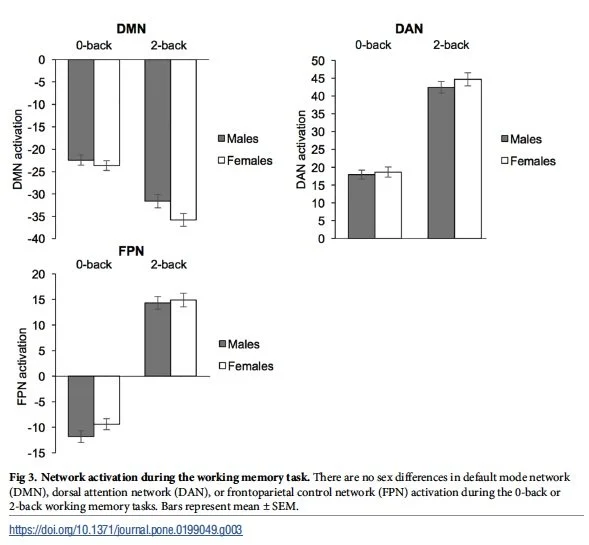
the Default Mode Network (DMN), responsible for internal processing, self-monitoring, and inner narrative
the Dorsal Attention Network (DAN), responsible for external vigilance, scanning, and threat detection
Suppressing emotion means toggling between both simultaneously — a form of mental multitasking that drains clarity, creativity, and working memory.
Researchers have found that women show greater DMN suppression and stronger DAN activation when exposed to conditions involving reward and punishment — situations that mimic social evaluation, judgment, and interpersonal consequences.
This matters for one key reason: The same neural state activated during reward/punishment vigilance is activated during emotional suppression.
Women’s brains shift into a heightened attention mode under evaluative pressure — the same pressure that often triggers suppression at work.
So when a woman is holding back what she genuinely thinks or feels, her brain is:
down-regulating internal emotional signals (DMN suppression)
up-regulating external scanning for risk (DAN activation)
running both networks harder than usual
This dual activation pattern explains why suppression feels mentally heavy: the brain is trying to regulate inner experience and track outer threat at the same time.
The cognitive cost
Behavioral science has long shown that self-monitoring consumes working memory, but this study adds something deeper: Women may experience an exaggerated neural load during evaluative moments — meaning suppression can demand even more cognitive effort from them compared to men.
That “foggy,” “muted,” or “I can’t think straight” feeling women describe in unsafe environments isn’t imagined.
It’s the cost of attention being split between emotional restraint and social vigilance.
THE RELATIONAL COST
Belonging Without Authenticity
In organizational psychology, the behavior of masking truth to maintain harmony is known as surface acting.
Amy Edmondson’s and Jane Dutton’s research on relational authenticity shows that surface acting creates a paradoxical state: you may be presenting as externally connected, however you are internally isolated.
On the outside, things seem smooth.
On the inside, belonging erodes.
Women may feel accepted — but not seen. Included — but not known.
Psychological safety researcher Amy Edmondson has shown repeatedly (2020–2023) that without environments where candor is safe and mistakes don’t cost connection, people default to silence.
But silence slowly corrodes trust — both between people and within oneself.
Belonging without authenticity is merely proximity, not connection.
THE IDENTITY COST
The Erosion of Self-Trust
Scholars Herminia Ibarra and Susan Ashford describe a phenomenon known as identity strain — the stress that emerges when a person’s internal truth consistently conflicts with their external behavior.
For women who habitually silence themselves:
instincts begin to feel unreliable
intuition becomes quiet
self-doubt increases
confidence becomes performative, not rooted
Over time, suppression creates an identity gap between the “authentic self” and the “adaptive self” — the version curated for approval or safety.
This is why many women say things like:
“I don’t feel like myself at work.”
“I’m present, but not fully there.”
“I feel like a visitor in my own career.”
Silence doesn’t just suppress expression — it suppresses identity.

Why Expression Regulates the Nervous System
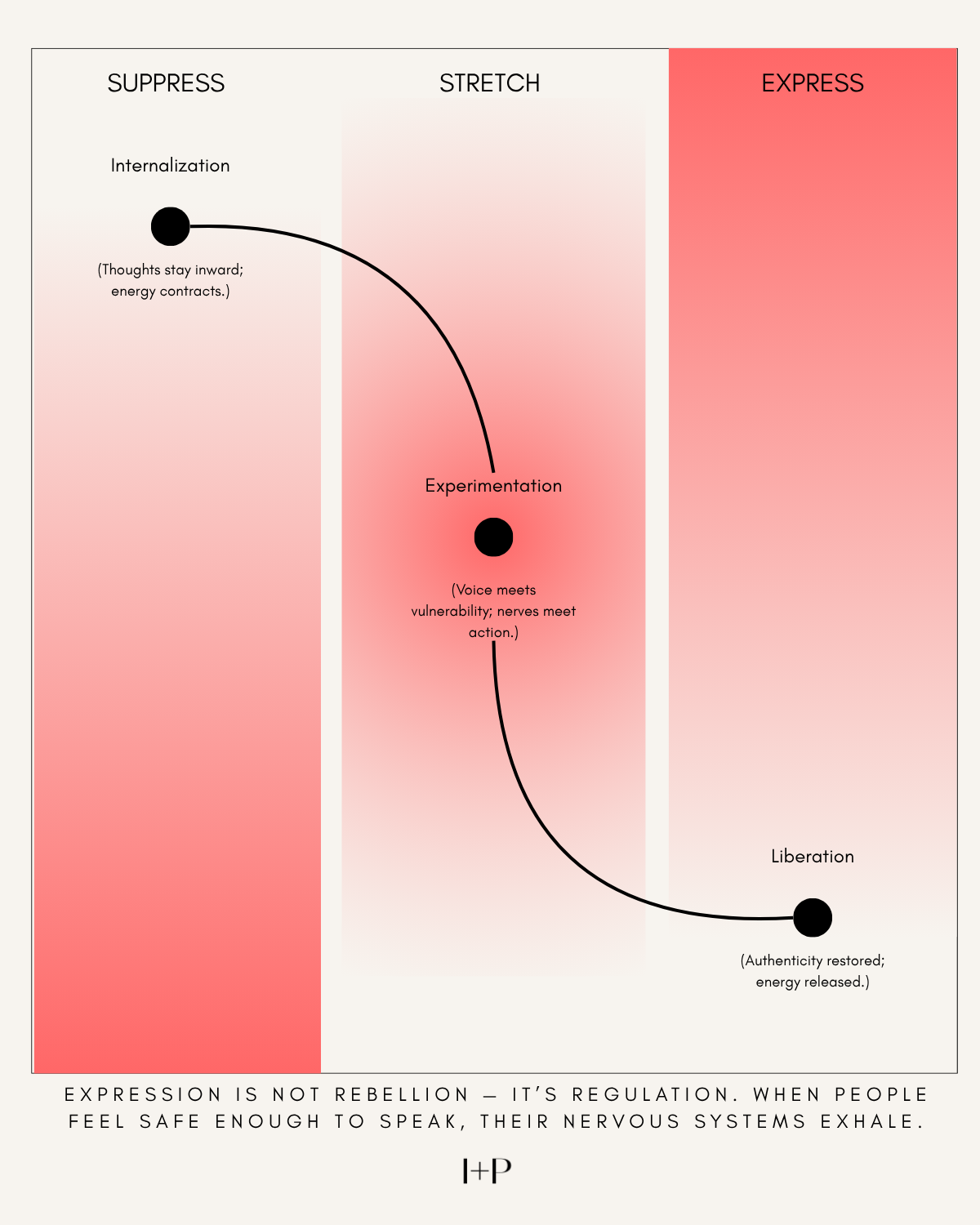
An important takeaway from this blog is: Expression is not an act of rebellion — it is an act of physiological regulation.
Neuroscience shows that authentic expression activates:
ventral vagal pathways, which support safety and connection
prefrontal cortex integration, which supports clarity
interoceptive accuracy, which strengthens self-trust
When a woman feels safe enough to speak, her nervous system shifts from contraction to expansion.
This is why psychological safety is not a “soft skill” — it is a biological imperative.
Edmondson’s 2021–2024 findings consistently show that teams with higher psychological safety do not just perform better — they recover faster from stress.
Candor is not a cultural luxury. It is a regulatory resource.
What Organizations Must Understand About Silence
Silence is often misinterpreted as professionalism.
But silence is frequently:
can be a sign of emotional labor
can be a signal of low safety
can be an indicator of cognitive overload
can be an early marker of burnout
When women aren’t speaking, it’s not because they have nothing to say — it’s because they risk something by saying it.
Organizations must move beyond asking for “more input” and create the conditions where expression does not cost psychological or social safety.
What Women Need to Restore Expression Without Risk
Women don’t need to be braver.
They need safer environments.
And until organizations fully get there, women can begin reclaiming expression by:
naming internal cues of suppression
sharing micro-thoughts in low-stakes contexts
practicing small experiments of authenticity
resourcing themselves with allies
separating “safety” from “approval”
honoring their body’s signals as data
Expression does not need to be loud.
It just needs to be true.
And truth, spoken in its smallest form, begins to unburden the system.
When People Feel Safe, Their Nervous Systems Exhale
Silence protects in the moment.
Expression restores in the long term.
The nervous system is always paying attention — not to what we present, but to what we hold back.
When workplaces create environments where speaking doesn’t cost belonging, women don’t just contribute more — they heal more.
Expression is not rebellion — it is regulation.
It is authenticity restored.
It is energy released.
It is the nervous system exhaling.
And it is the future of every healthy workplace.
REFERENCES
Gross, James J. “Emotion Regulation: Current Status and Future Prospects.” Psychological Inquiry, vol. 31, no. 3, 2020, pp. 1–26.
Edmondson, Amy C., and Zhike Lei. “Psychological Safety: The History, Renaissance, and Future of an Interpersonal Construct.” Annual Review of Organizational Psychology and Organizational Behavior, vol. 7, 2020, pp. 23–43.
Edmondson, Amy C. The Fearless Organization: Creating Psychological Safety in the Workplace for Learning, Innovation, and Growth. Wiley, 2019.
Dutton, Jane E., and Amy C. Edmondson. “Leading in Times of Trauma.” Harvard Business Review, July–Aug. 2019.
Dutton, Jane E., and Emily D. Heaphy. “The Power of High-Quality Connections.” Oxford Handbook of Positive Organizational Scholarship, Oxford UP, 2011.
Ibarra, Herminia, and Roxana Barbulescu. “Identity as Narrative: Prevalence, Effectiveness, and Consequences of Narrative Identity Work in Macro Role Transitions.” Academy of Management Review, vol. 35, no. 1, 2010, pp. 135–154.
Ashford, Susan J., and D. Scott DeRue. “Developing as a Leader: The Power of Mindful Engagement.” Organizational Dynamics, vol. 41, no. 2, 2012, pp. 146–154.
Dumais, Kelly M., et al. “Sex Differences in Default Mode and Dorsal Attention Network Engagement.” PLOS ONE, vol. 13, no. 6, 2018, e0199049.
